
Blog
Technology Comparison: When to choose Spray Drying, Fluid Bed, or Coacervation?
In advanced research, even for us at Sphera Encapsulation, protecting sensitive molecules is not just a technical challenge—it is a cornerstone for creating high-value products.
At Sphera Encapsulation S.r.l., the first Italian company fully dedicated to R&D in encapsulation technologies, we continuously evaluate which methodology delivers the best performance based on stability and release objectives.
Choosing between fluid bed, spray drying, and coacervation impacts not only product quality, but also production efficiency and the bioavailability of active ingredients.
Fluid Bed: Precision and uniformity in coating
The fluid bed process is based on suspending solid particles in a controlled airflow, allowing the system to behave like a dynamic fluid.
At Sphera, we leverage this physico-chemical phenomenon to coat and dry substrates in a single rapid step, producing core-shell structures with homogeneous and controlled coating films.
This technology is particularly effective for depositing functional coatings or for granulating fine powders to improve flowability and protection.
- High efficiency and operational speed in surface treatment
- Excellent compatibility with heat-sensitive molecules and products
- Broad versatility across multiple industries
- Optimal scalability for industrial production
These characteristics make fluid bed technology ideal for producing stable granules above 100–200 µm, ensuring uniform coating on each individual particle.
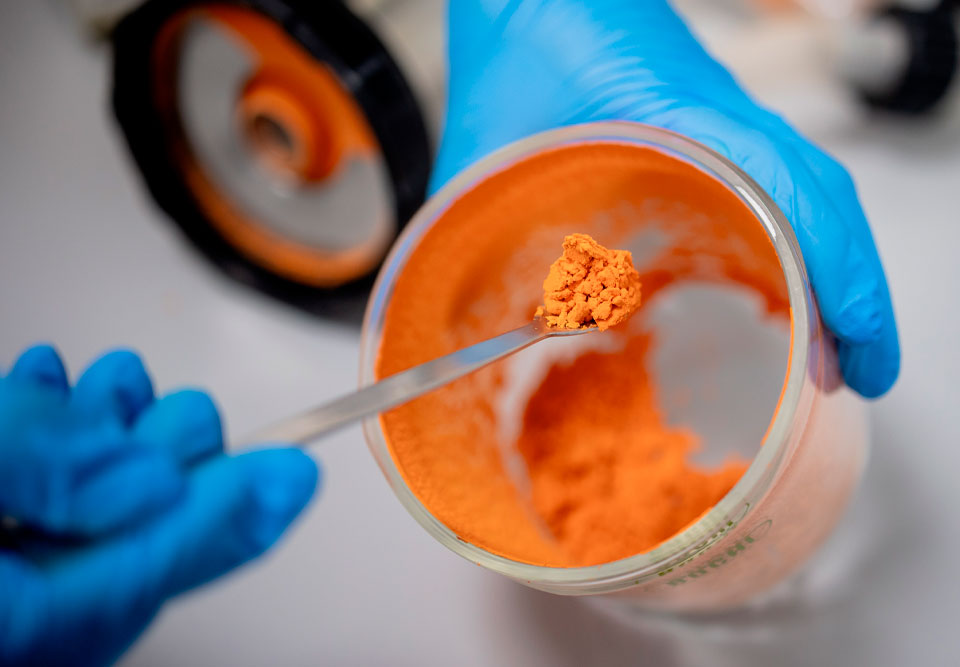
Spray Drying: The art of instant atomization with Sphera Encapsulation
Spray drying microencapsulation represents the gold standard for converting liquid systems—regardless of solids content—into ready-to-use powders.
Through atomization in a hot gas stream, the liquid is instantaneously transformed into a finely dispersed solid.
Despite the use of elevated temperatures, rapid evaporation protects both hydrophilic and hydrophobic actives from thermal degradation, making it one of the most advanced drying techniques available.
- Extremely fast and efficient process, easily scalable
- Fully adaptable to pharmaceutical, chemical, cosmetic, and food sectors
- Capable of processing diverse matrices, including thermolabile substances
With the ability to generate fine powders in the 5–50 µm range and achieve payloads up to 30–35%, spray drying remains the most versatile method for large-scale industrial distribution.
Coacervation: Phase separation for High Payloads
Complex coacervation is a microencapsulation technique based on liquid–liquid phase separation.
At Sphera Encapsulation, we use this process to create core-shell microcapsules containing oils or lipophilic substances, starting from homogeneous solutions of charged molecules.
The interaction between oppositely charged polymers forms a robust shell around active droplets, which is then stabilized using specific cross-linkers to ensure high mechanical resistance.
- Cost-effective due to efficient use of materials and polymers
- Significant increase in structural resistance and capsule stability
- High precision in isolating oil-based actives
This method stands out for producing microcapsules ranging from 1 to 1000 µm, capable of achieving exceptionally high payloads—up to 70–80% active ingredient.
Optimize your industrial assets with Sphera Encapsulation
Selecting the right technology is not always straightforward:
- Spray drying is ideal for ultra-fine powders and large-scale production
- Fluid bed excels in granulation and functional coating
- Coacervation is unmatched for high payload and oil protection
At Sphera, we provide a comprehensive methodological stack to transform your molecules into both digital and physical assets ready for the global market.
Choosing the right technology means preventing inefficiencies and maximizing product performance.
You can contact us by filling out our form.
Stay updated on the latest developments in microencapsulation and innovations from our laboratory—follow us on our social channels:

